Behind the Canvas
The Artistic Process
From photographic memory to abstract expression — a journey through the creation of each painting, guided by the Layer-drag technique.
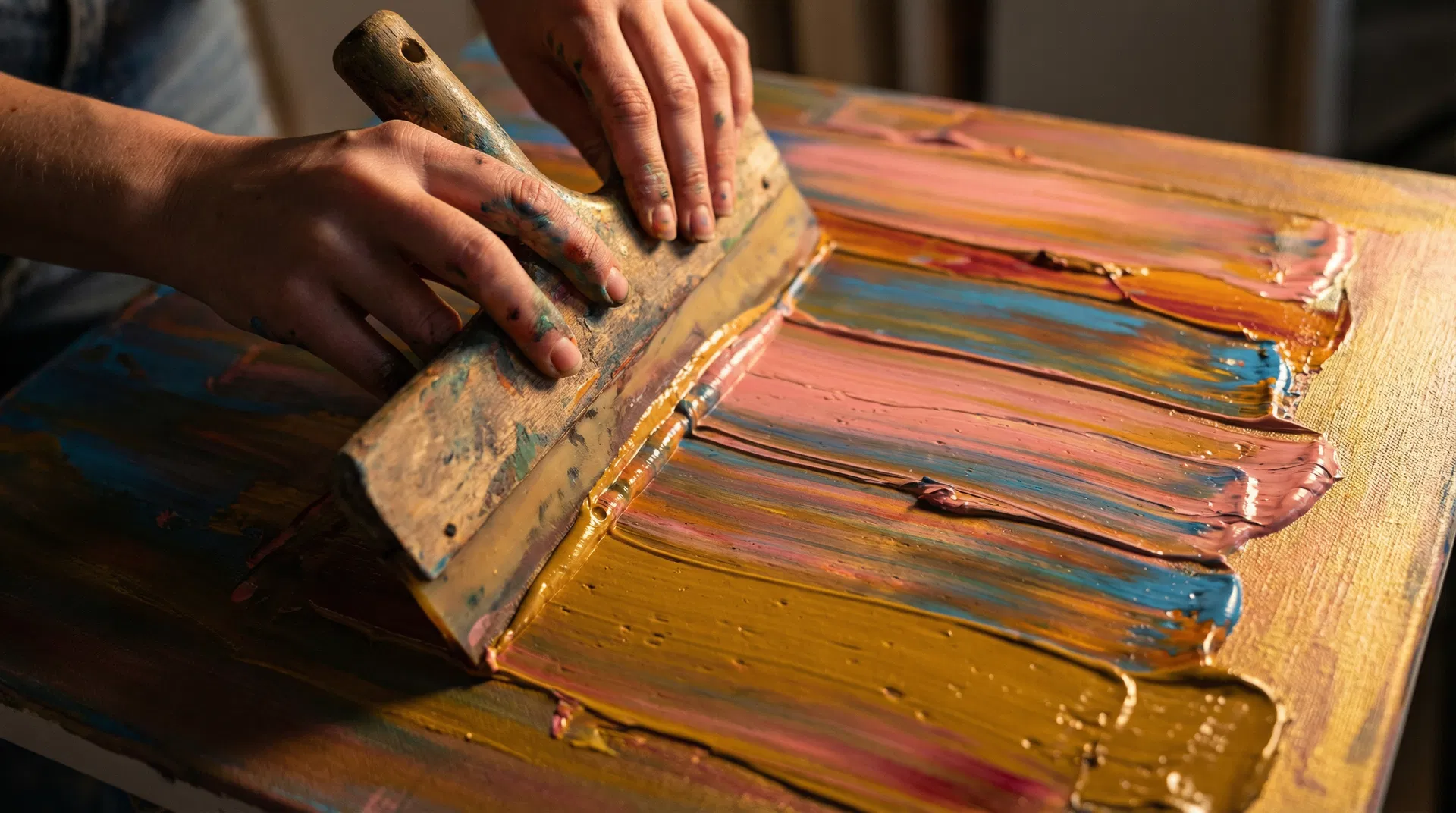
The Layer-drag technique — dragging acrylic & mixed media across the canvas surface
Photographic Source
Every painting begins with a photograph from India — a crowded street in Rajasthan, the blue walls of Jodhpur, a paddy field at dawn. These images serve as emotional anchors, not as templates to be copied. The photograph captures a moment; the painting will capture its essence.
Canvas Preparation
Large canvases (typically 80×100cm to 100×140cm) are prepared with a base layer of gesso and an initial wash of warm tones. The scale is essential — these are paintings meant to be experienced physically, to surround the viewer with color and texture.
Initial Color Layers
Thick acrylic and mixed media are applied directly to the canvas in bold, expressive strokes. Multiple colors are laid down simultaneously — golds, pinks, blues, oranges — creating a rich chromatic foundation. At this stage, the photographic reference is still visible in the composition.
The Squeegee
This is the transformative moment. A large squeegee is drawn across the wet paint surface in a single, decisive motion. The tool drags, blends, and redistributes the paint, creating the characteristic horizontal streaks and layers. Each pass is irreversible — there is no undo. The image begins to dissolve.
Layering & Revelation
Multiple rounds of paint application and squeegee work build up complex layers. Earlier colors peek through later ones, creating depth and luminosity. The painting develops its own logic, revealing forms and patterns that were not planned but emerge from the process itself.
Resolution
The final stage is one of careful observation. The artist steps back, studies the canvas, and decides when the painting has found its balance — when the tension between abstraction and figuration, between concealment and revelation, feels right. Some paintings resolve quickly; others require weeks of contemplation.
Global Perspective
Bridging Continents
E'dna's artistic vision draws from a lifetime of global experiences and cultural immersion. Her Layer-drag technique is rooted in modern abstractism. Her artworks emphasize the spiritual and emotional dimensions of color, texture, and form.
Her travels across the world have profoundly shaped her visual vocabulary. Each destination contributes unique color palettes, light qualities, and emotional resonances that become woven into her paintings.
The Layer-drag technique becomes her instrument of translation: it drags memories from clarity into abstraction, from the specific into the universal, creating a visual language that speaks across cultural boundaries.
Materials & Dimensions
Medium
- —Professional-grade Acrylic paints
- —Premium linen canvas
- —Custom-built wooden stretchers
- —Museum-quality varnish
Tools
- —Large industrial squeegees
- —Palette knives
- —Custommade brushes & Household instruments
- —Photographic references
Dimensions
- —Small: 80 × 100 cm
- —Medium: 100 × 120 cm
- —Large: 100 × 140 cm and bigger formats
- —Custom sizes available